

Are Oil Diffusers Bad for Your Lungs? The Science of Safe Home Scenting
What if the fragrance meant to elevate your sanctuary is actually compromising your breath? It's a question that haunts the modern home: are oil diffusers bad for your lungs? You value a refined environment, yet conflicting health reports and the fear of respiratory triggers can turn a moment of peace into one of doubt. You want the elegance of a scented home without the guilt of hidden toxins or the worry of triggering asthma in those you love.
We agree that your well-being is non-negotiable. This article promises to uncover the truth about respiratory safety, demonstrating how advanced diffusion technology protects your health while enhancing your space. We will preview the 2025 research regarding heat-based VOC risks, the importance of IFRA-compliant standards, and the science of cold-air delivery. Discover a world of curated, sensory perfection that remains pure, safe, and sophisticated. It’s time to move beyond outdated methods to a cleaner, more intentional way of scenting your environment.
Key Takeaways
- Distinguish between the risks of heat-based delivery and the safety of passive, cold-air aromatic diffusion for long-term wellness.
- Understand the molecular factors that determine if oil diffusers are bad for your lungs and how to choose high-purity formulations.
- Learn why cold-air nebulization is the gold standard for maintaining air quality without the complications of added humidity or standing water.
- Master the art of balanced scenting by utilizing precision timing and proper ventilation to ensure a serene, healthy environment.
- Discover how the Ensō diffuser's advanced technology offers total control over your sensory landscape through intentional, app-driven delivery.
Understanding the Respiratory Impact of Home Scenting
Atmosphere is art. We curate our homes to reflect a sense of serenity, often turning to scent as the final, invisible layer of design. Yet, a vital question persists for the health-conscious individual: are oil diffusers bad for your lungs? To answer this, we must look past the fragrance and examine the molecular interaction between scent and biology. When you inhale, you are engaging in a sophisticated exchange where microscopic particles travel deep into the respiratory system. While scent can elevate a mood, the wrong delivery method can lead to lung irritation or inflammation. The secret to safety lies in the intersection of purity, technology, and precise concentration.
The distinction between natural essential oils and synthetic fragrances is often blurred. Many assume natural equates to safe, but even pure botanicals can be problematic if poorly processed. High-quality scenting requires adherence to rigorous safety guidelines. Reputable manufacturers now align with the IFRA 51st Amendment standards as of early 2025, ensuring that fragrance ingredients meet strict safety thresholds. By choosing a refined system like the Ensō diffuser, you prioritize a delivery method engineered for both elegance and respiratory integrity.
What Are VOCs and Are They Always Dangerous?
Volatile Organic Compounds, or VOCs, are often misunderstood in the context of indoor air quality. VOCs are a neutral chemical classification that includes both scents and pollutants. Essentially, they are compounds that transition into gas at room temperature. This category is vast. It encompasses everything from harmful formaldehyde found in industrial adhesives to the refreshing d-limonene found in lemon oil.
Research from 2021 indicates that ultrasonic diffusers can release specific VOCs like eucalyptol and linalyl acetate. While these are natural aromatic components, their safety depends on concentration. The risk arises when these compounds react with ozone in the air to create secondary pollutants. A curated environment avoids this by using technology that prevents chemical alteration and maintains a balanced molecular profile.
How the Lungs Process Scent Molecules
The journey of a scent molecule is a swift transition from the environment to the self. It begins at the olfactory bulb and moves toward the lower respiratory tract. This biological path is the foundation of Aromatherapy, where botanical extracts are used to promote a sense of calm. However, the lungs are sensitive to particulate matter.
Concentration is the deciding factor between pleasure and irritation. A 2021 study measured particulate matter (PM1) emissions from various oils, noting that levels can fluctuate based on the oil type and water quality used. If concentration levels are too high, the body may respond with "red flag" symptoms. These include:
- Persistent coughing or throat dryness.
- Shortness of breath during diffusion.
- A heavy or tight sensation in the chest.
True luxury is never intrusive. By understanding how the body processes these elements, you can enjoy a beautifully scented home that supports your well-being without compromise.
The Science of Inhalation: VOCs, Particles, and Purity
Beyond the aesthetic charm of a scented room lies a complex biological reality. To truly understand whether are oil diffusers bad for your lungs, we must analyze the physical size of the particles we inhale. Standard scenting methods often release particulate matter, specifically PM2.5, which are ultra-fine particles less than 2.5 micrometers in diameter. These particles are small enough to bypass the body's natural filters, settling deep within lung tissue. Unlike traditional scents that may carry Hidden Health Risks of Air Fresheners through aerosolized chemicals, modern diffusion focuses on molecular purity and respiratory safety.
True luxury is safe by design. This is why following the International Fragrance Association (IFRA) standards is essential for any high-end environment. The 51st Amendment, updated in early 2025, provides the most rigorous guidelines for ingredient safety and concentration. Choosing oils that are IFRA-compliant ensures that your sensory experience is as responsible as it is refined. Pure. Safe. Precise. This is the definitive modern version of home scenting.
Particulate Matter: Measuring What We Breathe
Lung health is a matter of scale. Ultra-fine particles are the primary concern because they can trigger inflammatory responses in sensitive individuals. A 2021 study on ultrasonic diffusers found that PM1 emission rates varied significantly, with lemon oil reaching approximately 2 mg/h. By 2026 standards, maintaining safe indoor air quality relies on minimizing these emissions through superior delivery technology. Cold-air nebulization creates a dry mist of consistent, microscopic particles that remain suspended without clinging to surfaces or overloading the respiratory tract.
Thermal Degradation: Why Heat is the Enemy
Heat is a destructive force in the world of fragrance. When an oil is heated, its chemical structure changes through a process known as thermal degradation. This 'vaping' of oils can create new, potentially toxic chemical chains that were not present in the original botanical extract. A 2025 pilot study confirmed that heat diffusers generate VOC concentrations an order of magnitude higher than ultrasonic versions. Traditional candles and burners pose a greater risk than modern systems because they rely on combustion or high temperatures. To maintain the integrity of your environment, we recommend the precision-engineered Ensō technology, which uses cold-press diffusion to keep the oil's molecular structure intact. This method ensures that the fragrance you enjoy is exactly what nature intended, without the risks associated with thermal breakdown.
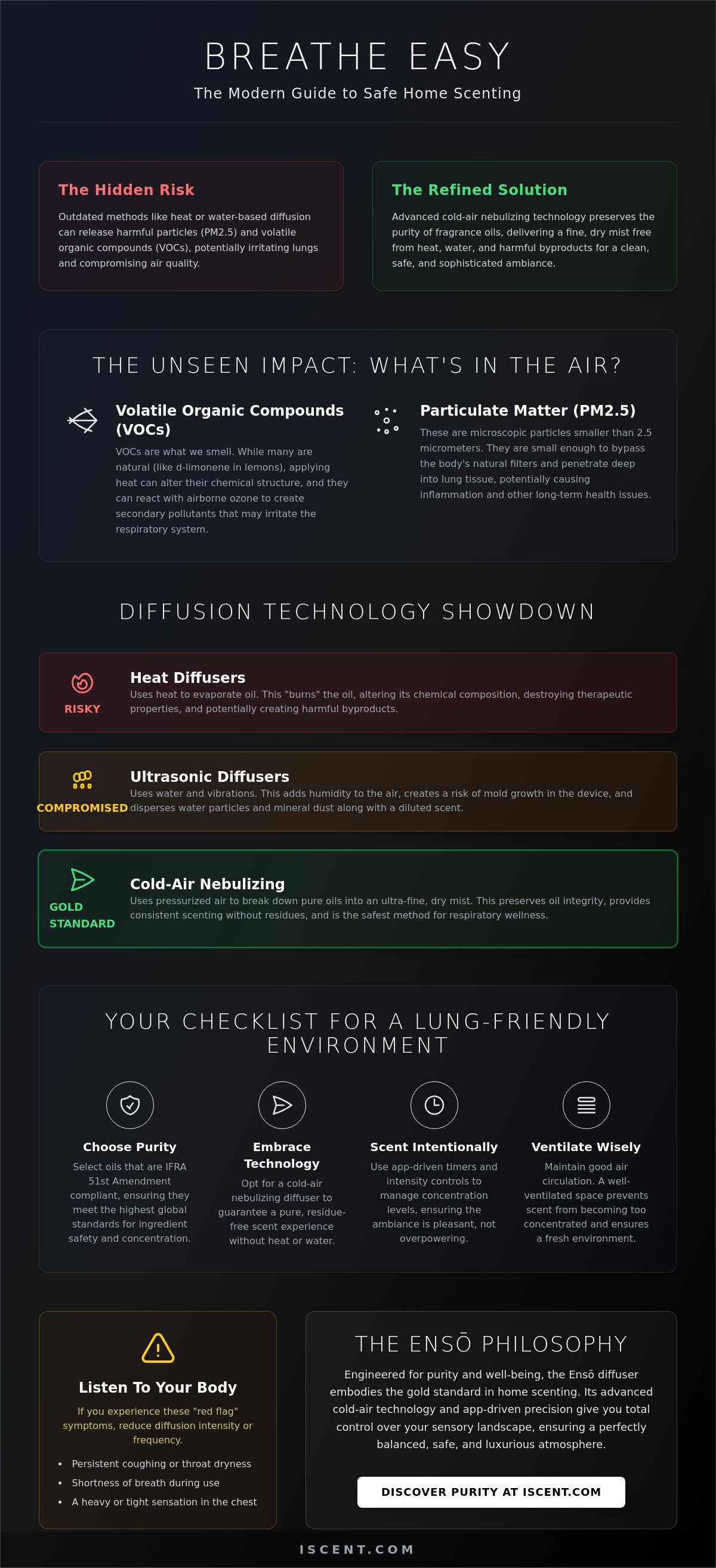
Comparing Diffusion Technologies: Ultrasonic vs. Cold-Air
Innovation defines the atmosphere. While the market is saturated with various scenting methods, the technology behind them dictates the health of your environment. When questioning if are oil diffusers bad for your lungs, it's crucial to distinguish between water-based systems and pure, anhydrous technology. Traditional methods often compromise air quality through unintended byproducts. In contrast, modern nebulization offers a definitive, refined version of home fragrance that prioritizes respiratory integrity. It is the intersection of nature and advanced engineering.
The delivery method is the most important factor in maintaining a pristine environment. High-end spaces require a system that respects both the architecture of the room and the biology of its inhabitants. By moving away from primitive methods, you enter a world of curated, sensory perfection. This is not just about scent. It's about the air you breathe.
The Ultrasonic Trap: Moisture and Microbes
Ultrasonic diffusers operate by creating a cool mist through high-frequency vibrations. This process requires water. While seemingly harmless, this moisture acts as a vehicle for minerals, bacteria, and mold. A 2021 study revealed that using tap water instead of deionized water in these devices led to a fivefold increase in PM1 emissions. These microscopic particles are then aerosolized and inhaled.
This phenomenon is closely linked to 'humidifier fever,' a respiratory reaction to contaminated water mist. Maintaining these systems requires constant, rigorous cleaning to prevent microbial growth. Without meticulous care, the very device meant to provide serenity can introduce irritants into your home. Adhering to essential oil safety guidelines means acknowledging that water-based diffusion is often less refined than modern alternatives. It's a compromise that sophisticated users no longer need to make.
Nebulization: The Sophisticated, Dry Alternative
Nebulization represents the pinnacle of sensory technology. These scent diffuser machines utilize the Bernoulli principle to transform pure fragrance oil into a dry, microscopic mist. No water is added. No heat is applied. This method ensures that the oil's molecular structure remains intact, preserving the delicate botanical profile. It's an effortless approach to luxury.
Dry diffusion offers several distinct advantages for the health-conscious minimalist:
- Elimination of mold and bacterial risks associated with standing water.
- Prevention of humidity-related damage to fine furniture and electronics.
- Consistent 'scent bloom' that fills a space evenly without over-saturation.
By removing the variable of water, nebulization provides a cleaner, more intentional experience. It is a masterclass in efficiency. The resulting mist is so fine that it remains suspended in the air longer, providing a steady, sophisticated aroma. This is the gold standard for those who value both aesthetics and well-being. It is a seamless fusion of technology and craftsmanship that ensures your sanctuary remains truly pure.
Best Practices for Lung-Friendly Home Fragrance
Scenting a home is an act of curation. It requires a balance between sensory impact and biological respect. If you find yourself wondering, are oil diffusers bad for your lungs, consider that the risk often stems from misuse rather than the medium itself. True luxury is never overwhelming. It is subtle, intentional, and precisely controlled. By following a few sophisticated best practices, you can ensure your environment remains a sanctuary of health and refinement.
Intentionality is the hallmark of the modern innovator. We move away from the "set and forget" mentality of the past, opting instead for a tech-forward approach that prioritizes air quality. When you control the concentration, you control the experience. This ensures that your home remains inviting, safe, and impeccably polished.
Strategic Scenting: Duration and Space
Air saturation is a common pitfall. Constant, 24/7 diffusion can lead to sensory fatigue and an unnecessary respiratory load. We recommend intermittent diffusion. This approach allows the olfactory system to reset and prevents the buildup of VOCs in enclosed spaces. It’s vital to match your device’s power to the specific volume of your room. A large hall requires a different output than a minimalist study. For detailed, room-specific tips, consult our Ultimate Guide to Essential Oil Diffusers. This resource offers a masterclass in remastering your home scenting experience.
Ventilation is the silent partner of fragrance. Adequate air exchange ensures that scent molecules circulate effectively without reaching irritating concentrations. This is especially critical for sensitive groups, including infants, pets, and the elderly. Their respiratory systems are more delicate. Lower concentrations and shorter diffusion cycles are essential for their comfort and safety. Fresh air. Controlled scent. Total serenity.
Quality Control: Ingredients Matter
The market is flooded with "therapeutic grade" claims, a term rooted more in marketing than in clinical science. Discerning users look for deeper markers of quality. Cheap oils often contain invisible fillers, phthalates, and parabens. These additives can act as strong respiratory irritants. A 2023 study on synthetic fragrances identified compounds like 3-ethylbenzaldehyde, which can cause significant irritation if not properly formulated.
In contrast, Ensō fragrance oils are laboratory-formulated for purity and performance. They are engineered to work seamlessly with cold-air technology, ensuring a lung-safe experience that never compromises on sophistication. By choosing oils that meet IFRA standards, you're investing in a product that values ethical integrity and respiratory health. Elevate your environment with a system designed for your well-being. Experience the precision of Ensō technology today.
The Ensō Philosophy: Engineered for Purity and Well-being
The Ensō philosophy represents a paradigm shift in olfactory art. For years, the question of whether are oil diffusers bad for your lungs has lingered because of outdated, unrefined delivery methods. We've moved beyond those limitations. The Ensō diffuser is a masterclass in cold-air technology, designed specifically for those who refuse to choose between luxury and well-being. It is the definitive version of home scenting. This system is tailored for the elite Dubai lifestyle, where health and aesthetics are inextricably linked. It is where modern innovation meets a deep respect for the human breath.
Sophistication requires control. Through the ISCENT app, users can manage their environment with surgical precision. This prevents the over-saturation issues often found in primitive devices. You can schedule scents to match your circadian rhythm, ensuring your space is inviting without taxing your respiratory system. Purity is paramount. For more intimate environments, the Ensō Mini brings this same professional-grade safety to smaller quarters. It is a seamless fusion of tech-forward design and health-conscious engineering.
Precision Engineering for Clean Air
Inside every Ensō device is a sophisticated internal mechanism engineered to maintain a consistent, microscopic particle size. This precision is vital. It ensures the fragrance remains suspended in the air without clumping into larger, irritating droplets. Our closed-loop system is another hallmark of our commitment to purity. By preventing oil oxidation, we ensure the chemical profile of your fragrance remains stable and safe from start to finish. To find the perfect fit for your home, you can compare the Ensō and Ensō Mini to see which sculptural design suits your specific square footage. Refined. Controlled. Healthy.
A Curated Sensory Experience
We believe that scenting is an act of wellness. It is the final layer of a health-conscious home. Our signature scents, such as Velvet Serenity, are crafted to evoke calm while adhering to the highest safety standards. ISCENT is not just a provider of hardware. We are curators of an elevated lifestyle. By remastering the luxury home scenting experience, we've turned environmental fragrance from a potential hazard into a therapeutic asset. It is a world of curated, sensory perfection.
Your sanctuary deserves nothing less than perfection. When you choose a system engineered for purity, the concern regarding if are oil diffusers bad for your lungs becomes a statement of confidence. Breathe deeply. Enjoy the refinement. Experience the future of olfactory art as an intentional act of self-care. This is scenting reimagined for the modern minimalist.
Embrace the Future of Olfactory Wellness
True luxury is the seamless harmony of aesthetics and health. We have explored how advanced cold-air nebulization preserves molecular integrity, why waterless systems eliminate microbial risks, and the vital role of high-purity ingredients. The answer to whether are oil diffusers bad for your lungs depends entirely on the technology you choose to welcome into your home. By moving away from primitive heat and water-based methods, you prioritize respiratory safety without sacrificing sensory elegance.
Your sanctuary deserves a definitive, modern version of home scenting. Our system utilizes IFRA-compliant fragrance oils and precision engineering to create a dry, microscopic mist. It is the same trusted technology used by 5-star hotels across the UAE to maintain an atmosphere of curated, sensory perfection. Pure. Safe. Sophisticated. Remaster your home atmosphere with the lung-safe Ensō Diffuser today. Breathe deeply and step into a world where your well-being is the ultimate masterpiece.
Frequently Asked Questions
Can essential oil diffusers cause pneumonia or lung infections?
Essential oil diffusers can contribute to lung infections if they aerosolize pathogens from stagnant water. Ultrasonic models that use a water tank are particularly susceptible to mold and bacterial growth. Switching to a waterless, cold-air system eliminates the moisture reservoir where these microbes thrive. This ensures your sanctuary remains a place of purity and health rather than a source of airborne irritants.
Are waterless diffusers safer for the lungs than ultrasonic ones?
Waterless diffusers are significantly safer for respiratory health than traditional ultrasonic versions. By removing water from the equation, you eliminate the risk of inhaling aerosolized minerals and bacteria. These systems utilize cold-air nebulization to maintain the molecular integrity of the oil. This technology provides a cleaner, more intentional experience that avoids the "humidifier fever" often associated with water-based mists.
Is it safe to sleep with an oil diffuser running all night?
Running a diffuser all night is only recommended if the device offers precision, intermittent control. Continuous operation can lead to over-saturation, which might trigger irritation. Sophisticated systems like the Ensō allow you to schedule short bursts of fragrance via an app. This approach ensures a serene atmosphere while giving your respiratory system necessary breaks. It's a tech-forward way to balance sensory luxury with well-being.
What are the symptoms of 'diffuser lung' or respiratory irritation?
Common symptoms of respiratory irritation include persistent coughing, shortness of breath, and a dry or scratchy throat. Some individuals may also experience chest tightness or wheezing. If you find yourself asking, are oil diffusers bad for your lungs, these physical cues are your body's way of requesting better ventilation or lower oil concentrations. Recognizing these signs early allows you to adjust your environment for optimal comfort.
Are diffusers safe for people with asthma or COPD?
Individuals with asthma or COPD must approach home scenting with extreme caution. While cold-air nebulization is the most refined and least irritating method, strong scents can still act as triggers. It's best to use low concentrations in large, well-ventilated spaces. Always consult with a medical professional before introducing new aromatic elements into an environment shared by those with chronic respiratory conditions.
Can I use an oil diffuser around my baby or small children?
You can use a diffuser around children if you prioritize high-purity oils and adequate air exchange. Infants have more sensitive lungs, so diffusion should be kept to a minimum in their direct vicinity. Use only IFRA-compliant oils that are known to be gentle. Ensuring the device is placed in a large room with steady airflow prevents the concentration from becoming overwhelming for their smaller respiratory systems.
Do oil diffusers leave a film on furniture that can be inhaled later?
Water-based ultrasonic diffusers often leave a damp film that can trap dust and particles on surfaces. This residue can later be disturbed and inhaled. In contrast, cold-air technology produces a dry mist of microscopic particles that remain suspended in the air. This anhydrous delivery ensures that your fine furniture remains pristine and your indoor air stays free from heavy, settling droplets.
How often should I clean my diffuser to ensure it's safe for my lungs?
Cleaning frequency depends entirely on the technology you use. Ultrasonic diffusers require deep cleaning every three to four days to prevent mold buildup. If you use a waterless Ensō system, maintenance is remarkably minimal. Because there's no water to stagnate, you only need to wipe the exterior and occasionally flush the nozzle. It's a sophisticated, low-effort solution for the modern minimalist.
 2026©. All Rights Reserved.
